
Mohammed Al-Durah Death
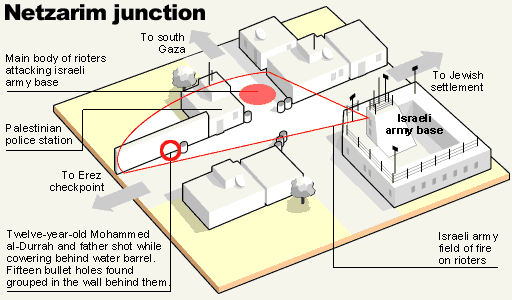
Conclusions of the IDF investigation into why Mohammed Al-Durah could not have been shot from the IDF outpost: “The most important piece of physical evidence was the concrete barrel. In the TV footage it clearly bears a mark from the Israeli Bureau of Standards, which enabled investigators to determine its exact dimensions and composition. When they placed the equivalent in front of a concrete wall and put mannequins representing father and son behind it, a conclusion emerged: soldiers in the Israeli outpost could not have fired the shots whose impact was shown on TV. The evidence was cumulative and reinforcing. It involved the angle, the barrel, the indentations, and the dust.
Mohammed al-Dura and his father looked as if they were sheltering themselves against fire from the IDF outpost. In this they were successful. The films show that the barrel was between them and the Israeli guns. The line of sight from the IDF position to the pair was blocked by concrete. Conceivably, some other Israeli soldier was present and fired from some other angle, although there is no evidence of this and no one has ever raised it as a possibility; and there were Palestinians in all the other places, who would presumably have noticed the presence of additional IDF troops. From the one location where Israeli soldiers are known to have been, the only way to hit the boy would have been to shoot through the concrete barrel.
This brings us to the nature of the barrel. Its walls were just under two inches thick. On the test range investigators fired M-16 bullets at a similar barrel. Each bullet made an indentation only two fifths to four fifths of an inch deep. Penetrating the barrel would have required multiple hits on both sides of the barrel’s wall. The videos of the shooting show fewer than ten indentations on the side of the barrel facing the IDF, indicating that at some point in the day’s exchanges of fire the Israelis did shoot at the barrel. But photographs taken after the shooting show no damage of any kind on the side of the barrel facing the al-Duras—that is, no bullets went through.
Further evidence involves the indentations in the concrete wall. The bullet marks that appear so ominously in the wall seconds before the fatal volley are round. Their shape is significant because of what it indicates about the angle of the gunfire. The investigators fired volleys into a concrete wall from a variety of angles. They found that in order to produce a round puncture mark, they had to fire more or less straight on. The more oblique the angle, the more elongated and skidlike the hole became.
The dust resulting from a bullet’s impact followed similar rules. A head-on shot produced the smallest, roundest cloud of dust. The more oblique the angle, the larger and longer the cloud of dust. In the video of the shooting the clouds of dust near the al-Duras’ heads are small and round. Shots from the IDF outpost would necessarily have been oblique.
In short, the physical evidence of the shooting was in all ways inconsistent with shots coming from the IDF outpost—and in all ways consistent with shots coming from someplace behind the France 2 cameraman, roughly in the location of the Pita road”
Unaswered questions that raise doubt about the incident:Why is there no footage of the boy after he was shot? Why does he appear to move in his father’s lap, and to clasp a hand over his eyes after he is supposedly dead? Why is one Palestinian policeman wearing a Secret Service-style earpiece in one ear? Why is another Palestinian man shown waving his arms and yelling at others, as if “directing” a dramatic scene? Why does the funeral appear—based on the length of shadows—to have occurred before the apparent time of the shooting? Why is there no blood on the father’s shirt just after they are shot? Why did a voice that seems to be that of the France 2 cameraman yell, in Arabic, “The boy is dead” before he had been hit? Why do ambulances appear instantly for seemingly everyone else and not for al-Dura?
https://www.theatlantic.com/magazine/archive/2003/06/who-shot-mohammed-al-dura/302735/
